MCUs for Digital Power Control Applications
16 May 12

Many digital power control applications operate
by using complex digital signal processing algorithms in dedicated processing
devices, such as FPGA’s or DSP processors, that are designed to perform only
one particular function. Microcontrollers haven’t been used in these instances
because they weren’t able to continually process large amounts of data
simultaneously from several input sources. Each input source would contain a
digital data field that may at some specified width, such as 8, 16, or 32 bits.

These applications are usually designed to
process this data at the highest possible speed and resolution while meeting
certain power consumption and cost requirements.
Engineers are limited in their
choice of a processing unit, as there are usually very few devices available
that would perform the intended function. And once a choice is made, the device
would only perform the one function it is designed for, and offers very limited
flexibility.
Because of the complexity of the design, the costs almost always
turn out to be much greater than the cost needed to implement a standard
microcontroller into their design. The main reason for the increase in cost is
that each dedicated processing unit needs specific software and other
development tools that are unique to the particular device.
A general purpose
MCU would have the advantage of having a standard software development tool
that could be used over and over for other applications.
Renesas Electronics Corporation has taken a step in providing a
possible solution to this problem with the new 32bit RX62G group, which is an
extension of its RX600 microcontroller family.
These MCUs provide a unique
combination of advanced analog features, processing power, high resolution
capability and integrated timer functions. These features make the new RX62G
MCUs ideal to implement high-accuracy digital control for a variety of digital
power control applications, including motor control with power factor
correction, power management, digital power supply, uninterrupted power
supplies, and inverters/converters.
The new MCU enables complex algorithms to be
implemented for processing data, along with precision control outputs at high
resolution.
This can now be done at an affordable cost with standard software
development tools, and enables much higher efficiency in digital power control
applications. The RX62G group, which is based on high performance 32bit RX CPU
core, comes with a comprehensive support ecosystem that provides a robust platform
for digital power control applications. Renesas claims the RX62G group is the
industry's first group of general purpose MCUs to provide this level of
combined high resolution and extreme performance capability.
The new MCUs operate at 100MHz to achieve 165
Dhrystone MIPS (DMIPS) performance, and provide maximum power efficiency when
operated at lower speeds while delivering high performance at higher speed.
Integrated DSP functionality and floating point unit (FPU) enable efficient
implementation of complex algorithms and control loops. The single-precision
FPU runs separately from the RX62G CPU and simplifies decimal-point
calculations, which can boost overall processing performance and simplify
firmware development. With an embedded flash that works at CPU speed with no
wait state, the RX62G delivers a real-time performance 165DMips at 100MHz in a
pure deterministic manner.
The new series or processors feature four
high-resolution timers capable of generating PWM signals with the high resolution
(312.5psec) needed to control power bridges, inverters, or converters with
maximum efficiency and lower power losses. When the high accuracy control is
used for controlling digital power supplies in applications like servers or
general power supply systems, high efficiency power management is possible.
Similar to the RX62T MCUs, the RX62G devices
feature two 12-bit A/D converters and one 10-bit A/D converter unit that can
capture analog input values from up to 20 channels at a minimum conversion time
of 1 second. Each of the A/D converters can be triggered by timer units and can
sample three phases in parallel. The RX62G MCUs also integrate a new 16-bit
general-purpose pulse-width-modulation timer (GPT), and MTU3 multifunction
timer-pulse units specialized for motor control. With this combination, one
RX62G MCU can control up to three 3-phase motors simultaneously.
These new MCUs expand on the advanced analog and
control features of the RX62T and RX63T devices, but provides enhanced
performance and more efficient power consumption. The safety functions and
peripheral functions of the RX62G group are upward compatible with those of the
RX62T group. The safety functions enable fail-safe control for devices which
use the RX62G group. The RX62G is also pin-compatible with the RX62T series,
and software compatible with other members of the RX600 family. This offers
better scalability options for changing design requirements for on a variety of
different applications.

Battery monitor chip from ST
13 May 12

The new STC3105 battery
monitor from STMicroelectronics
provides the precision voltage and current measurements needed to
implement a low-cost ‘gas gauge’ for portable electronic devices, such as in smart phones, tablets, and digital cameras.
Accurate predictions of the battery state-of-charge
and time-to-empty can be made while monitoring the charge/discharge status of
the battery. These features can extend battery life, extend operating time between charges, and
help avoid unnecessary recharging. All these features are contained in a 2 x 3
x 0.8 mm package while consuming only a few micro-amps of current.
The
STC3105 uses precise voltage and current measurements of the battery to estimate the
battery’s state-of-charge (SOC).
A Coulomb counter is used to keep track of the state-of-charge and
to track when the battery is charging or discharging. This Coulomb
counter method is combined with the current and open-circuit voltage
measurements to estimate the battery capacity and to supervise and track the charge/discharge
status. The microcontroller can program the Coulomb counter, set the SOC base
register value and read the charge register through the I2C interface. The
voltage monitoring accuracy is about 0.5%, and by using an external sensing
resistor, Coulomb counter accuracy is 1%.
A battery relaxation timer is used to
measure the time interval that initiates when the battery charger is removed or
when the current falls below a programmable load current threshold, which means
the battery is in a light-load condition. The relaxation counter register is
read from the I2C interface and can be checked to make sure that the battery
voltage had enough time to relax from the last time the current was high or
charging. The timer also indicates when an OCV
(Open Circuit Voltage) measurement should be made for SOC correction.
A
programmable alarm output provides a warning signal of a low State-Of-Charge
(SOC) condition and/or a low battery voltage. The SOC and voltage thresholds are
both programmable through the I2C interface.
The STC3105 also helps to extend the battery
runtime and lifespan with several power-saving features that not only reduce
its own power consumption, but the total power consumed by the application.
There are two operating modes, the active mode, which draws 100 μA,
and the power-saving mode, which draws 50 μA. There are also two sleep modes,
the standby mode, which draws 2 μA, and the power-down mode, which draws 1 μA.
This
device can initiate the necessary power-management functions when the battery
is nearly empty without involving the system microcontroller, and free the
microcontroller for other tasks or enable it to spend a longer time in a sleep
mode. This can further increase battery life by decreasing overall power consumption,
which will extend the time between charges.

New USB2Serial dev platform
12 May 2012

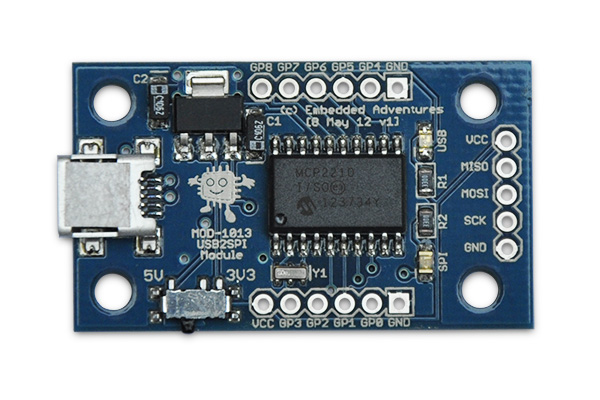
We're delighted to have the new PLT-1003 USB development platform available. Completely revised PCB, all surface mount, with more microcontroller pins broken out for your own nefarious purposes.

All you need to do is solder your own female or male headers as you require, and you're off and running. You can just it just as a TTL serial converter - or reprogram it to your own requirements.
In the coming weeks we'll be adding tutorials with new firmware to talk to some of our other devices, making it easier to try modules before building your own projects.

New LED Matrix driver board
11 May 12

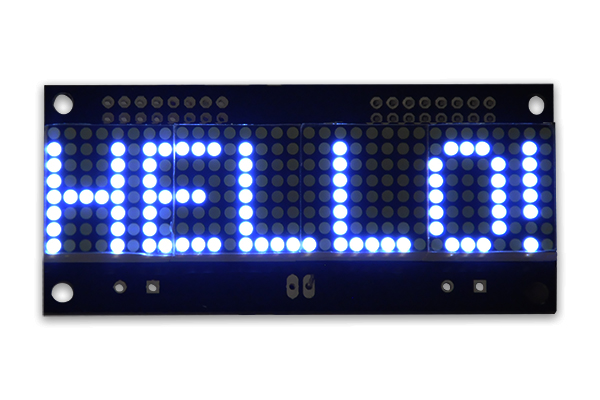
It's great having lots of LEDs to display graphics and text. Our LED matrix displays are a great way of doing just that. They have a simple serial interface - except that you need to update them row by row, over and over to light up the entire display.
No problems, there is code available to do that, both for Arduino and also the PicPack library.
But sometimes, you just want to display something without having to use all your precious CPU power flipping I/O pins.
Enter: the new PLT-1001 LED Matrix Display Driver board.

Cranking it up to version 4 of this board, this board gives you 16mips of processing power to keep all those LEDs flicker free.
We will be shipping it with firmware that allows you to issue simple serial commands to "Draw a circle" or "Print some text" without requiring any programming or understanding of the LED matrix displays themselves.
The other neat feature is that you can either attach a male 8x2 connector on top of the board and cable it directly to your LED Matrix Display, or solder on a female 8x2 connector under the board - and the board will attach as a "backpack" to the LED panel (for 80x8 and 64x8 boards it is the right size for the mounting holes).
Other than soldering on the connector you want to use - and terminal blocks (supplied) to connect power, the board is completely surface mount, pre-build and tested. You may need to update the firmware using a TTL serial connector for the type of LED Matrix display you wish to connect it to.
We are waiting on final PCB delivery from our manufacturing partners, and as soon as we have them available, we'll let you know. To register your interest, please email us at sales [at] embeddedadventures.com.

New Coilcraft power inductors
11 May 2012
Circuit designers usually try to use capacitors
rather than inductors in their circuits because of their smaller size, reduced
interference effects, and ease of manufacture.
Coilcraft, Inc. has introduced a type of coil design that has made it
easier to make use of coils in circuits where an inductance would work
better than capacitance, such as oscillators, tuned circuits, and resonant
circuits.
Coilcraft’s new PFL family of coils is especially
designed for applications that require ultra-small inductors that can still
handle significant current levels.

The PFL series comes in a wide assortment of
footprints that would fit in a variety of applications. The new PFL4514 and
PFL4517 are the latest additions to the PFL line of miniature power inductors.
These low-profile inductors feature a magnetic shield, which reduces the
effects of magnetic coupling between components, and allows for tighter
component spacing without electromagnetic interference. The unique PFL design
provides the same performance as found in the larger standard-sized inductors,
so circuit designers can now increase board density at a low cost without
sacrificing any efficiency.
The PFL4514 and PFL4517 are wirewound
surface-mount inductors that feature very low profiles.
The PFL4514 Series
Shielded Power Inductor requires only 16 mm2 of board space and is 1.4 mm high.
The 4.2 A current handling capability compares to much larger inductors. The inductance
values of the PFL4514 Series range from 1.0 µH to 22 µH and feature an
operating temperature range of -40 to +125°C. The DC resistance of the PFL4514
is relatively low, as low as 80 milli-ohms, making it more suitable for
battery-powered devices.
The PFL4517 Series features and even lower DC
resistance, which can be as low as 40 milli-ohms. Inductance values ranging
from 0.68 µH to 10 µH are offered for the PFL4517. The PFL4517 is taller than
the PFL4514 by 0.3 mm, and is designed for higher current levels up to 6.5A.
These low-profile, magnetically shielded
inductors share a common footprint for design and prototyping flexibility.
These devices have a composite-core construction with relatively heavy gauge
windings to provide the high current handling capability and low DC resistance.
The parts are halogen-free and RoHS-compliant, with matte tin over nickel
terminations that are compatible with 260°C processing.
Coilcraft offers free evaluation samples on its
website to qualifying designers, or a combined Designers Kit C451 can be
purchased, which contains three samples of both the PFL4514 and PFL4517 in a
range of values.
|