
EMBEDDED ADVENTURES: CONNECT THE WORLD AROUND YOU

- Home»
- News»
- All News Articles»
- New Development Platforms
28 Mar 12
Many people think that microcomputers are complex digital electronic devices with an embedded circuit board and software code that is way beyond the scope of their understanding. They may know how to operate a device through its external user-defined functions, but they have no idea how it actually works internally.
Even though the software code and circuit components do seem complex in a digital circuit, the fundamental processes that take place inside are actually just based on a simple base-two number system, where a digit can either be a '0' or '1'.
This would even be simpler than the base-ten number system that is used normally in everyday life, where the digits can be '0' to '9'. This base-two system is known as a 'binary' number system, and a '0' or '1' can also be thought of as being either 'on' or 'off'.
What makes the computers complex is the vast amount of '0's and '1's stored inside of it and the various processes of manipulating these '0's and ‘1’s through hardware logic or software logic.
Even this can be simplified by the fact that as a binary number becomes an input to a hardware or software logic structure, another binary number will appear on the output based on the function built into the logic structure. For example, an AND gate will have a logic '1' output only when both inputs are also '1'; otherwise the output is '0'. All the circuitry inside a microcontroller chip can actually be built by using thousands of these little integrated AND gates along with another simple gate called an 'inverter', which has one output that is always the opposite of its input.
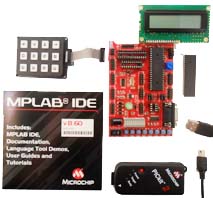
Kanda – Embedded Results Ltd uses these simplified concepts with a new kind of training program for learning basic embedded system development skills. They have just come out with a new PIC kit where even a beginner without any prior knowledge of electronics or programming can learn the fundamentals of developing and building a customized microcontroller-based circuit. The training program starts out by discussing the binary number system as described here, and then moves on to learning about the structure of a microcontroller. Then it progresses on to teaching assembly language before finally discussing the C language.
The kit is designed for Microchip's PIC16F and PIC18F series of microcontrollers, and includes a PICkit2 debugger and programmer which connect to the Kanda PIC development board.
This would allow single stepping through the code (either assembly or C) so the circuit can be analyzed one step at a time. Microchip’s MPLAB development software is used with the programmer and debugger and these are learned about as needed in the final stages of the training program. MPLAB is a powerful tool, as it contains a built in editor, assembler, C compiler, and simulator. It can also load the PIC microcontroller with the finished code.
Many code samples are provided to assist in programming as a programmer can quickly develop input/output software routines based on these examples.
The course starts by covering simple topics like reading the inputs from switches and energizing outputs for LEDs, and then moves on to inputting from keypads, and outputting to seven-segment displays and LCDs. Analog to Digital Conversion is covered also, so a circuit can be used with analog devices. Designers would be able to quickly develop instrumentation and robotics projects.
Everything needed for PIC training is included right in the package. There are switches, LEDs, ADC, EEPROM socket, and a UART interface built into the board, and there is also an LCD module and a keypad included with the kit. The PIC board supports most 8, 14, 20, 28 and 40-pin PIC microcontrollers in PIC16F and PIC18F families, and allows easy access to all peripheral functions.